50 ads for the Newsletter Accelerator — and the reasoning behind every one.
We read $103,524 of this account's own spend history, found three things that
overturned our first conclusions, then built 30 statics, 10 videos and 10
motion pairs against what survived — three times, because the first two visual builds were
rejected and rebuilt from scratch. This page is the working, including every part where we were wrong.
01 — What we were handed
The account, as it actually is
$103,524Lifetime spend
9,119Registrations (normalized)
$11.35Blended cost / registration
132Ads with spend
One account, Sep 2025 to Aug 2026. Two offers — a free 75-minute workshop
(“Build A $10k/Month Newsletter”) and the Personal IPO Summit, a free two-day
event. Two audiences the account itself names: Newsletter ICP and
Agency ICP. 28 distinct pieces of body copy across 134 creatives.
Every figure on this page comes from a direct Meta Graph API pull against the
ad account on 2026-08-27, not from a dashboard. The pull scripts are in the vault next to this
build so any number here can be re-derived.
02 — The first thing we got wrong
A $2,325 “total failure” was actually a top-quartile ad
Our first pass ranked every ad on Meta's lead action and produced a tidy list of
losers. Top of it: DCT_107 — $2,325 spent, zero leads. Next to it
DCT_112, $2,560 spent, zero leads.
Both numbers were artifacts. This account has changed its conversion event three
times:
Era
Campaign
Conversion event
Nov 2025
Qualified leads
Custom: “Lead q” + “Lead nq”
Mar 2026
Mar 2026 $10k Newsletter Webinar
complete_registration
Jun 2026 →
NLA Webinar Funnel / NLA WINNERS
lead
Normalized, the ranking inverts.DCT_107 drove
249 registrations at $9.34. DCT_112 drove
281 at $9.11. Both are top-quartile. Had we optimized on the raw pull, we
would have killed two of the account's better performers and briefed away from what worked.
Two more ads (PC 1, PC 2, ~$3,945) had no conversion event
at all — they were video-view campaigns. They are excluded here by objective, never
scored as failures.
03 — The second and third things we got wrong
Two findings we had to withdraw
Both were caught by adversarial review — three independent models (Gemini 3.1 Pro,
GPT-5.6, and a Claude reviewer with repo access) scoring the analysis, plus our own re-testing.
They are on this page because the corrections are more instructive than the original claims.
“Video length is the strongest predictor” — withdrawn
We measured corr(length, cost) = +0.570 across n=27 and nearly wrote a hard
20-second cap into the brief. But n=27 was ad rows, and those rows re-run only
9 distinct video files — one of them 9 times. At the level of distinct assets
the correlation falls to +0.371 (n=9), and it isn't monotonic: the two
longest videos in the account (55.8s → $12.38, 57.7s → $10.34) beat the shortest
(10.2s → $12.24). The account also has no videos at all between 17.8s and 36.6s,
so a “20-second” threshold sits in a gap with no data on either side of it.
It survives stratification (within-NLA r=+0.500, within-PIPO r=+0.814) so it is a real
signal — but it is a hypothesis, not a finding, and it cannot carry a
production rule. So we did the opposite of capping: six videos ship as a deliberate
duration ladder — the same script at 12s, 20s and 35s, twice — so the
question can actually be settled with spend instead of asserted.
“CTR doesn't predict cost” — overstated
corr(CTR, cost) = −0.027, which we initially read as “CTR has no
predictive power.” The 95% confidence interval is roughly
−0.30 to +0.25. That is absence of a detected linear association
in this sample, not evidence of no relationship. The honest version: CTR is not usable
as a proxy here — don't brief for scroll-stop alone. One ad in this account hit
21.4% CTR at $17.18 per registration.
04 — The question the account cannot answer
Are the cheap registrations the ones that buy?
Every number on this page — every one — is a cost per registration. Registrations
are not the business. Attendance is a step, and a paid enrollment is the outcome.
For one window in Nov 2025, this account measured lead quality, via two
confirmation-page conversions named “Lead q” and “Lead nq”.
It is the only quality data the account has ever produced:
Ad
Spend
Qualified
Unqual.
Qual. rate
Cost / qualified
Cost / any lead
DCT_112_Founders
$2,560
113
168
40.2%
$22.66
$9.11
DCT_111
$704
18
50
26.5%
$39.12
$10.35
DCT_114_Social is HARD
$311
7
24
22.6%
$44.43
$10.03
DCT_113_Life Hack
$248
0
18
0.0%
—
$13.78
DCT_115_Confession
$29
0
3
0.0%
—
$9.67
Total
$3,853
138
263
34.4%
$27.92
$9.61
The gap between $9.61 and $27.92 is a 2.9× multiplier, and the
qualified rate swings from 0% to 40% depending on which creative brought the person in.
Then the account stopped measuring it. Everything since June 2026 optimizes bare
lead.
What this does not show, and we want to be exact about it: there is
no ranking inversion here. DCT_112 is the cheapest ad on raw cost and the
cheapest on cost-per-qualified. The effective sample is four creatives, one of
which supplies 70% of all leads and 82% of qualified ones, in a single era on a single offer.
Calling it “66% of your leads are noise” would overstate it — 65.6% were classified
unqualified under one historical rule that nobody has validated against revenue.
The ask. The join that would settle this is
registrations → webinar attendance → paid enrollments, split by angle and
    era
— it lives in GoHighLevel, beehiiv and SamCart, not in Meta. With even a
directional version of it, the exploit arm below can be re-ranked by
cost per buyer instead of cost per lead. Without it, we are all optimizing a
metric nobody has tied to revenue. Restoring the q/nq split costs one landing-page change.
05 — What the winners actually look like
The design system, reverse-engineered
The account's best static and its worst video are 3× apart on cost per registration.
They are also visually opposite, which turned out to be more useful than any correlation.
Best static — $6.82 Cream drafting paper, deep-navy condensed
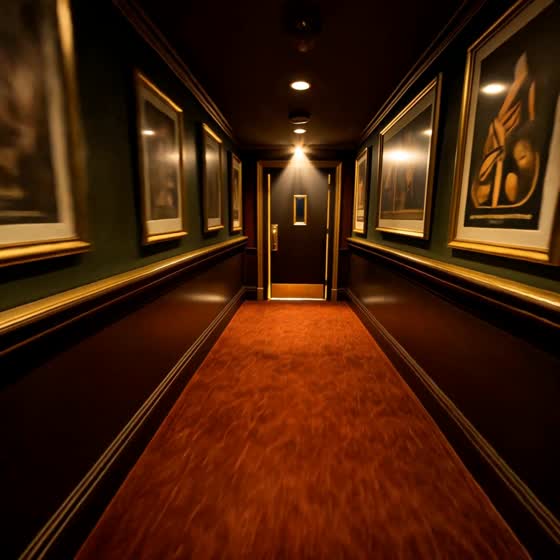
grotesque, gold CTA bar, registration marks, a measured 90-day axis. Editorial, not social.Best video — $7.37, 17.7s Cinematic gallery corridor. Premium,
aspirational, and no text on the opening frame.Worst video — $23.71, 46.9s Flat purple gradient, generic
karaoke captions. Template-social. 2.6× the length of the winner, 3.2× the cost.
The pattern we took forward: premium and editorial wins; generic-social-template
loses. Every static below is built in the blueprint system decoded from that first
image — cream ground, navy Anton condensed, ochre CTA, drafting furniture — rendered as HTML
through headless Chrome so the typography is exact by construction.
06 — How the 50 were allocated
30 exploit, 20 explore — locked before anything was generated
The brief was explicit: don't just iterate on what already works. So the split is structural,
not aspirational. Each unit carries an immutable arm and rationale, frozen in
manifest.json and hashed before the first render
(3ad30a69…), so post-hoc reassignment would be visible in version history.
The split also holds within each format, which is what stops “explore”
quietly becoming statics-only.
Rationale
Evidence grade
Arm
Static
Video
Flex
Total
R1 — proof density (named person + number in the hook)
Finding
exploit
10
0
2
12
R2 — duration ladder, identical script at 12/20/35s
Hypothesis
exploit
0
6
0
6
R4 — blueprint system extended, plus breaks as controls
Finding
exploit
6
0
2
8
R5 — Agency ICP rebuilt on Newsletter-ICP structure
Hypothesis
exploit
2
0
2
4
R3 — qualification-forward copy that repels bad fits
Hypothesis
explore
4
1
1
6
R6 — whitespace angles never run in this account
Untested
explore
8
3
3
14
Total
30
10
10
50
The explore arm is sourced deliberately, not invented: proof assets that have only ever
appeared buried in body copy and never as a hook (Nezha, Julia, Daria, the $2,000-a-call anchor),
curriculum material that has never been in an ad at all (sponsor sales, digital products, media
kits), and framings absent from all 18 primary bodies. Three units are reserved to
contradict our own conclusions: two videos at 35s against the length hypothesis, and
two statics that deliberately break the design system.
07 — Compliance
Some of these may fail review, and here is exactly why
Meta is already rejecting ads on this account. Rejection notices landed on
7/2 (7 ads), 7/3 (3), 7/30 (4) and 8/3 (3), with multiple failed appeals through July and
August 2026. The specific triggering clause was never diagnosed internally.
Two policies are in play. The obvious one is earnings claims. The one we think is actually
biting is Personal Attributes — Meta prohibits asserting or implying a viewer's
financial status, and the account's live copy does it constantly:
“you're stuck under $10K a month”,
“IF YOU'RE AN AGENCY OWNER UNDER $10K A MONTH”,
“your newsletter isn't making you AT LEAST $10K/month”. The offer headline
itself — “Build A $10k/Month Newsletter In 90 Days” — is a second-person
income promise with a timeframe.
So we did not treat the existing copy as a safe ceiling. 48 of the 50 units carry no
second-person income framing at all: claims are attributed to a named person and stated
in the past tense about what that person did. That is a deliberate compliance posture, and it is
also why the copy reads differently from what has run before.
No guarantee language anywhere. The landing page says 180 days, the FAQ
still says 90, checkout adds an undefined “100% Satisfaction Guarantee”, and no
document states when the clock starts. That contradiction has already cost a $1,500 refund.
It needs resolving before any ad mentions a guarantee.
No cohort dates. The next cohort is unconfirmed — the only source saying
“October” is explicitly marked outdated.
Blast radius. This ad account sits in the same Business Manager as TFM's
client accounts. A strike is not contained to this property.
Still required: a human sign-off on every income claim, confirming both
substantiation and that the named student consented. “It already ran” is not
approval.
07b — The wave that got rejected
The first build was killed on sight — and the kill was correct
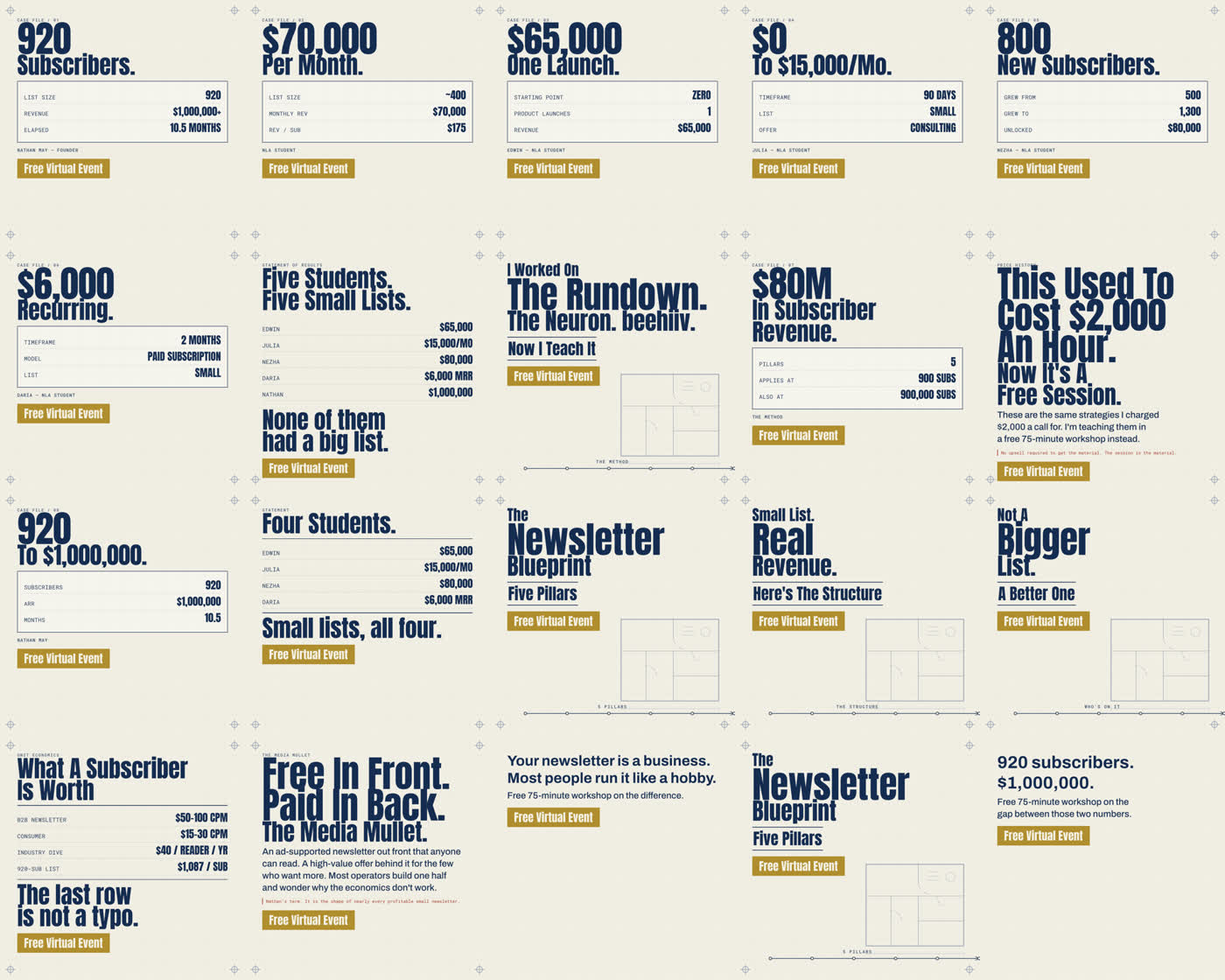
Wave 1 rendered all 40 statics as pure HTML typography on a flat cream ground. It was
compliance-perfect and visually dead: forty near-identical cards, no imagery, dead space at the
bottom of half of them. The client's review lasted one sentence: “these are
terrible.” He was right.
Wave 1 (rejected) — exact text, zero cinema. The mistake wasn't
craft, it was architecture: no image layer at all, because image models can't be trusted
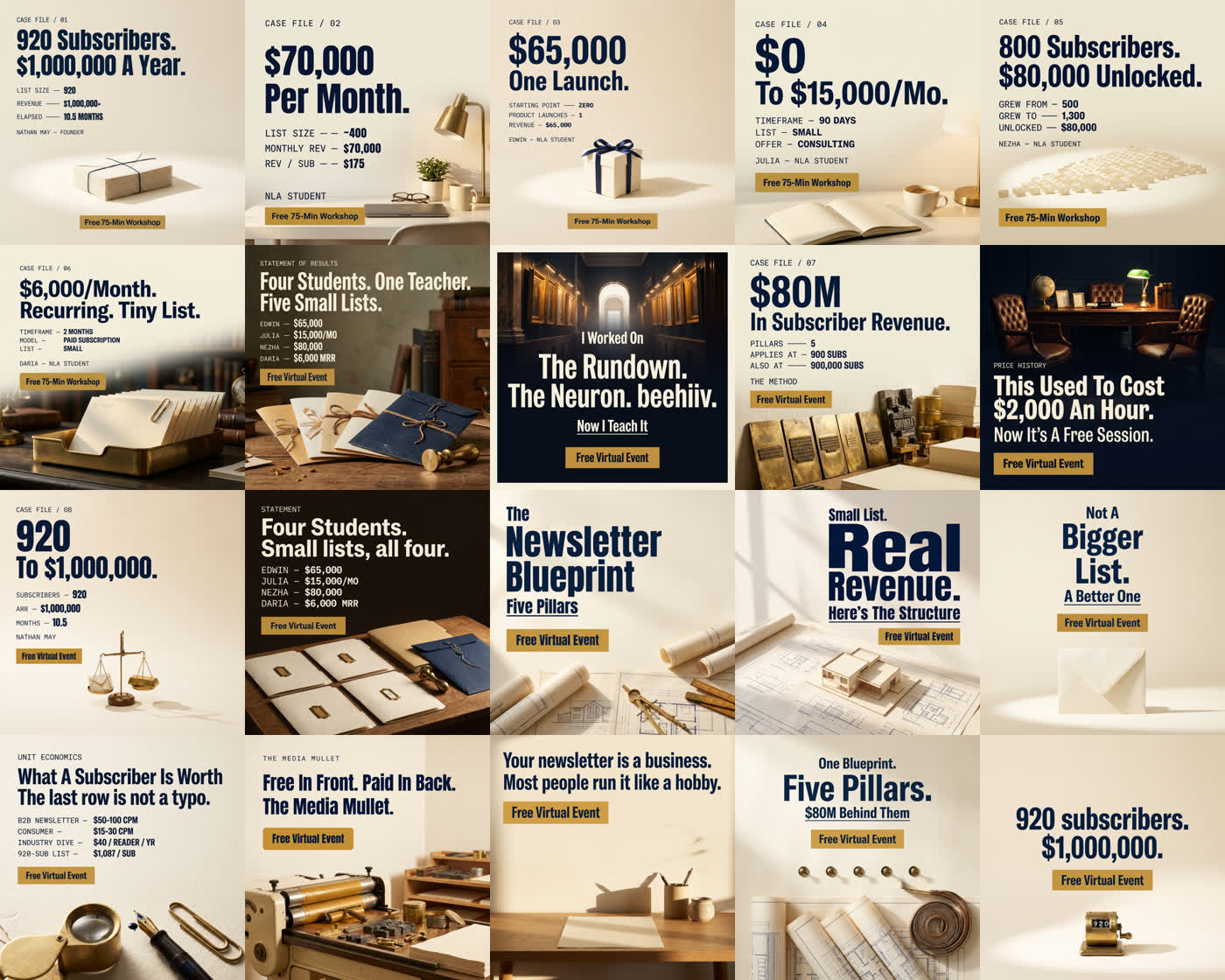
with words.Wave 2 (shipped below) — a generated photographic plate under
exact composited type. The model does the cinematography; the HTML does the words.
Wave 2 fixed the imagery — a GPT Image 2 photographic plate under
HTML-composited type — and was rejected too: the compositor shipped line-collision bugs, and the
whole architecture rested on a premise (“image models can't render text”) that had
only ever been tested on local models. It is false for frontier models.
Wave 3 — what ships below — is a full-model ensemble. Every unit was
generated end-to-end, text included, by two engines in parallel: Higgsfield's
Nano Banana Pro and Google's
Gemini 3.1 Flash Image, from prompts carrying the exact copy,
scene world and palette. Every candidate was OCR-checked for character-exact text fidelity by
qwen3-vl running on a local RTX 5090, then a blind judge reviewed all 40 pairs
against the account's real $6.82 winner and picked each shipping unit. Where both candidates
failed, the unit was regenerated on an assigned engine. Final routing: 30 Nano Banana Pro,
9 Gemini Flash, 1 Gemini 3 Pro. The losing candidates are the argument for the
ensemble: a misspelled “PASSVE”, a stray paren inside “$1,000,000).”,
duplicated CTAs, a kerning artifact reading “Raiłsed” — each caught and outvoted by
the sibling engine.
The judge also caught our bug. It reported both engines dropping the fourth
row of every data table and recommended abandoning model generation for those units. The real
cause was a [:3] slice in our own prompt builder — the engines never saw the rows.
One character of Python, misattributed to two frontier models by everyone except the evidence.
Fixed, regenerated, verified.
08 — The exploit arm
30 units built on what the account already proves
Proof-density, the blueprint system, the Agency-ICP reframe, and the duration
ladder. Each card carries its rationale and, where relevant, why it exists.
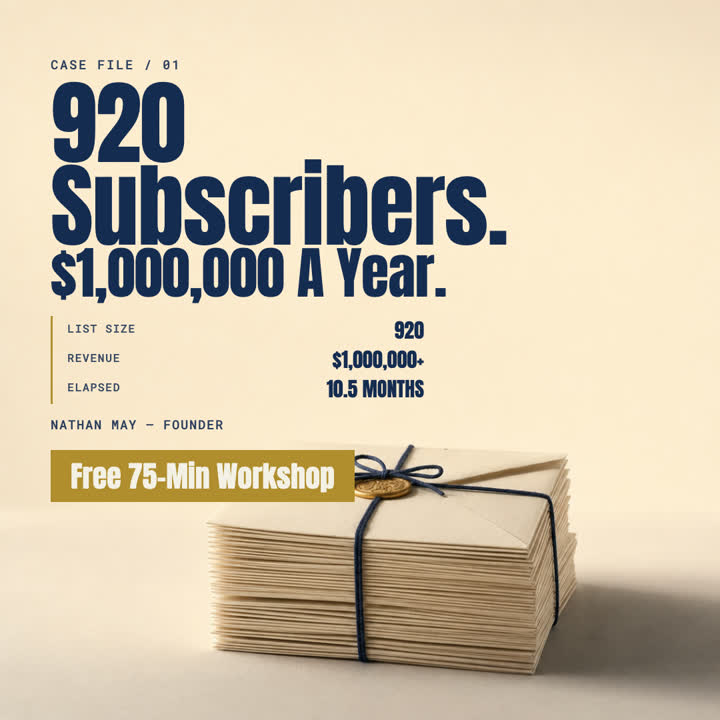
NLA-01 · A 920-Subscriber Newsletter
exploitR1staticno 2nd-person income claim
I built a newsletter to $1M ARR in 10.5 months. It had 920 subscribers.
Not 92,000. Nine hundred and twenty.
The number of people on the list turned out to be the least important variable. What mattered was who was on it and what I offered them.
I'm teaching the whole method in a free 75-minute workshop.
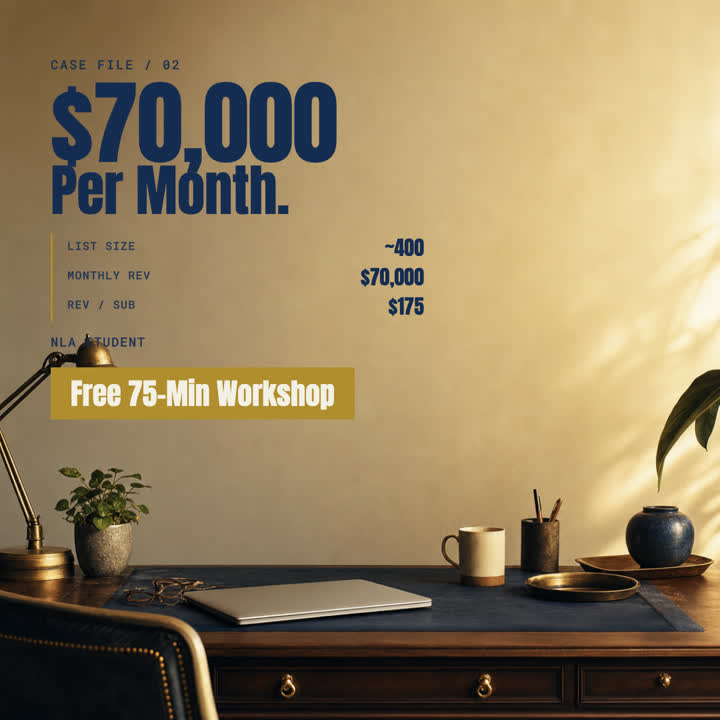
NLA-02 · 400 Subscribers. $70,000/Month.
exploitR1staticno 2nd-person income claim
One of my students runs a newsletter with roughly 400 subscribers.
It makes $70,000 a month.
That is about $175 per subscriber, per month. Most newsletters with 40,000 subscribers do not come close to that, because they are selling attention instead of outcomes.
I'm breaking down exactly how she structured it, free.
NLA-03 · Edwin Started At Zero
exploitR1staticno 2nd-person income claim
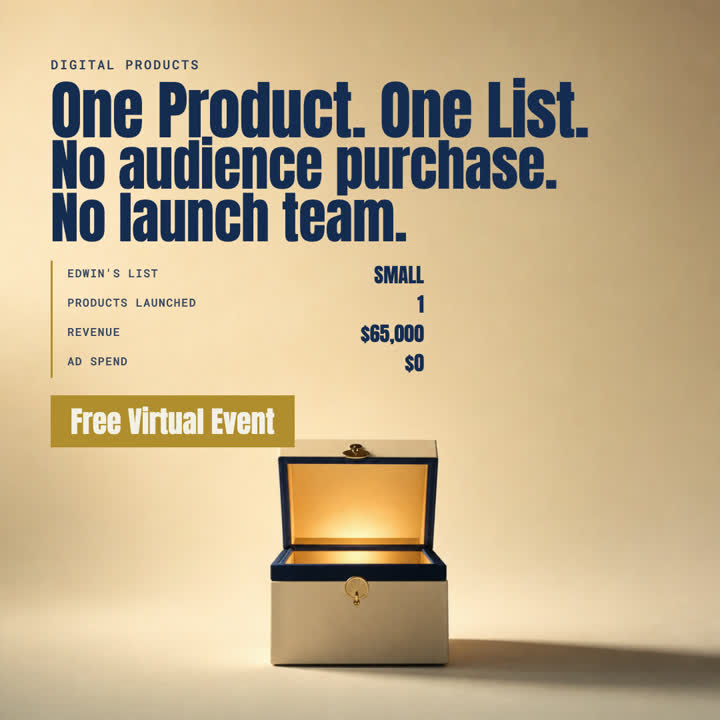
Edwin started at zero.
One digital product, launched to his own newsletter list: $65,000.
He didn't buy an audience, run ads, or go viral. He built a small list of the right people and made them one offer that fit.
Free 75-minute workshop on the exact sequence.
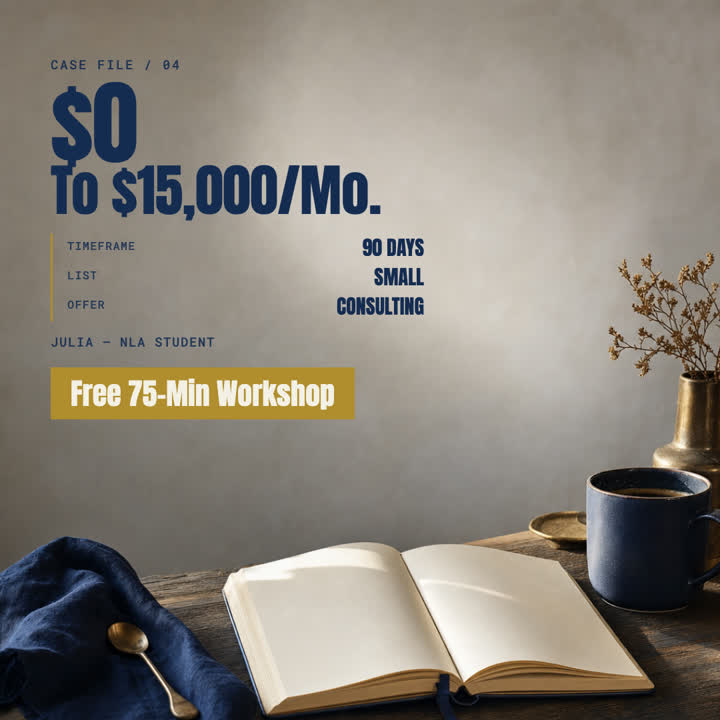
NLA-04 · Julia's First 90 Days
exploitR1staticno 2nd-person income claim
Julia went from $0 to $15,000 a month in 90 days.
She did not grow her list first. She took the small list she already had and put a consulting offer in front of it.
Most people have the audience and are missing the offer. Julia had both within a quarter.
I'm teaching the structure free.
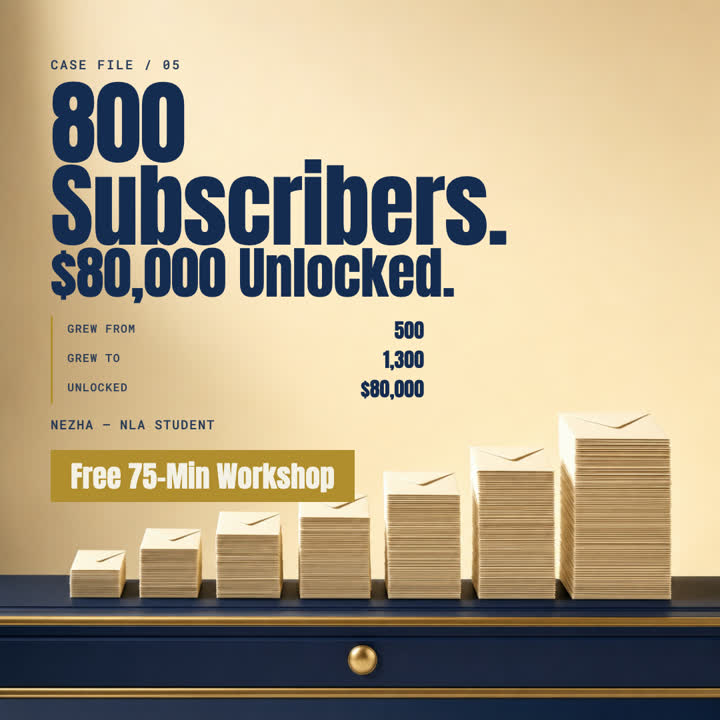
NLA-05 · 500 To 1,300 Subscribers
exploitR1staticno 2nd-person income claim
Nezha added 800 subscribers.
That one move unlocked $80,000 in project opportunities.
800 subscribers is a rounding error to most newsletter operators. It was a business to her, because she knew precisely who she wanted reading it.
Free workshop on how to fill a list with buyers instead of numbers.
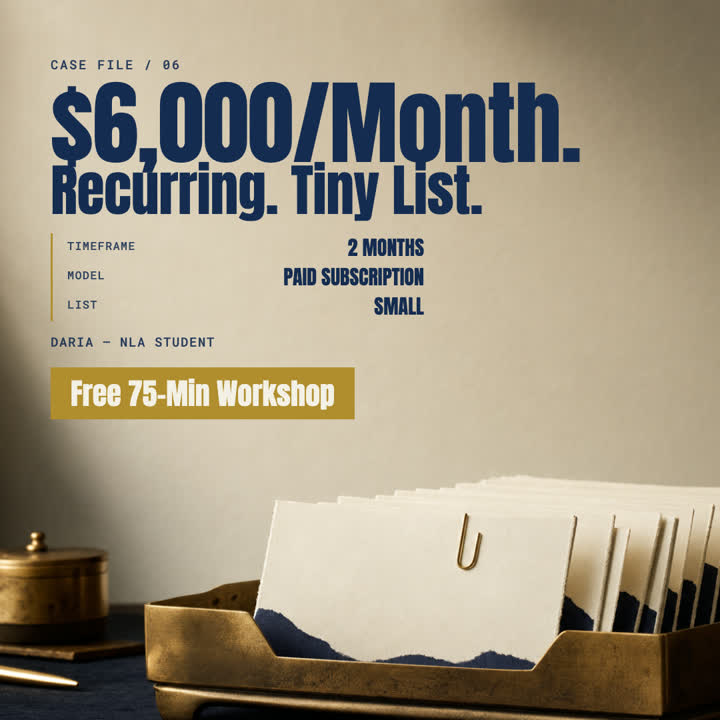
NLA-06 · $6,000 Recurring In 2 Months
exploitR1staticno 2nd-person income claim
Daria launched a paid subscription to her list and hit $6,000 in recurring revenue in two months.
Recurring is the part that matters. She isn't relaunching every month to stay flat — the base compounds.
I'm walking through how to structure a paid tier a small list will actually pay for. Free.
NLA-07 · Five Small Lists
exploitR1staticno 2nd-person income claim
Edwin: $65,000 from one launch. Julia: $0 to $15,000 a month in 90 days. Nezha: 800 new subscribers, $80,000 in project work. Daria: $6,000 recurring in two months. Me: $1M ARR from 920 subscribers.
Not one of these came from a big list.
Free 75-minute workshop on what they did instead.
NLA-08 · The Rundown. The Neuron. beehiiv.
exploitR1staticno 2nd-person income claim
I work with some of the biggest newsletters in the world — The Rundown, The Neuron, beehiiv, Arnold's Pump Club.
The strategies behind them are not exotic. They're five repeatable pillars, and they work at 900 subscribers as well as they work at 900,000.
I'm teaching all five in a free 75-minute session.
NLA-09 · The Five Pillars
exploitR1staticno 2nd-person income claim
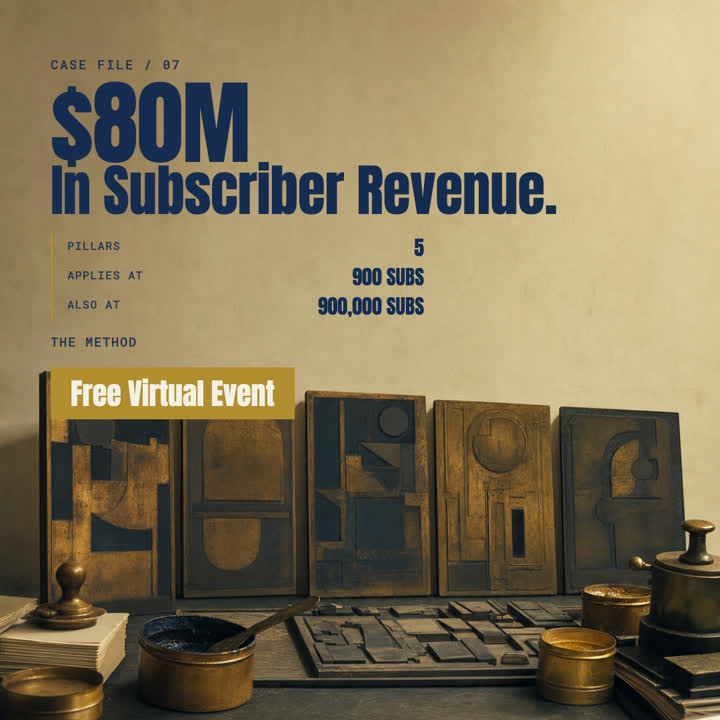
Five pillars sit behind more than $80M in subscriber revenue across the newsletters I've worked on.
They are not five growth hacks. They're the boring structural decisions — who the list is for, what it sells, and when.
I'm teaching all five, free, in 75 minutes.
NLA-10 · Formerly $2,000 A Call
exploitR1staticno 2nd-person income claim
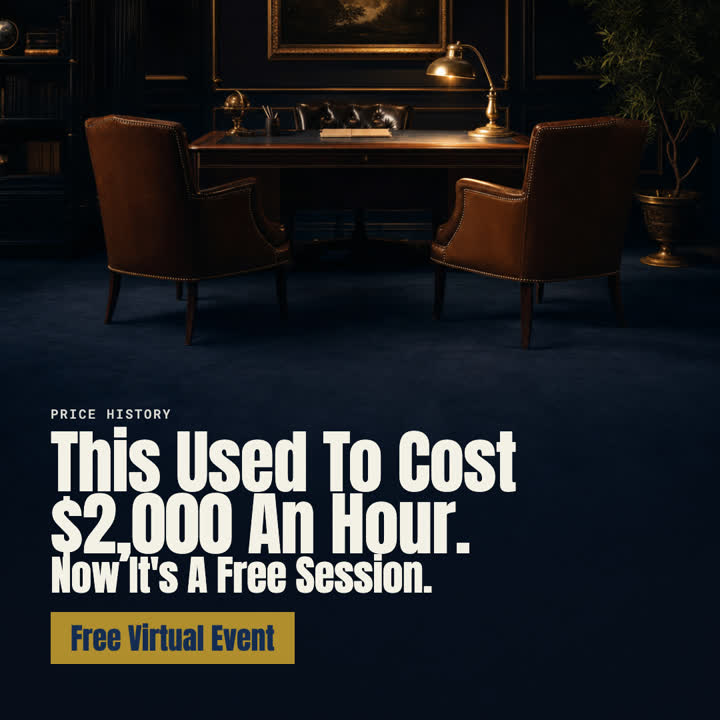
These are the same strategies I used to charge $2,000 a call for.
I'm teaching them in a free 75-minute live session instead — the five pillars behind more than $80M in subscriber revenue.
Come with a newsletter or come with an idea. Both work.
No upsell required to get the material. The session is the material.
NLA-11 · 920 → $1,000,000
exploitR1flexno 2nd-person income claim
920 subscribers. $1M ARR. 10.5 months.
The list size is the least interesting number on that line.
Free 75-minute workshop on the other two.
Motion: counter-roll on the 920 → $1,000,000 figure, 5s
NLA-12 · Four Small Lists
exploitR1flexno 2nd-person income claim
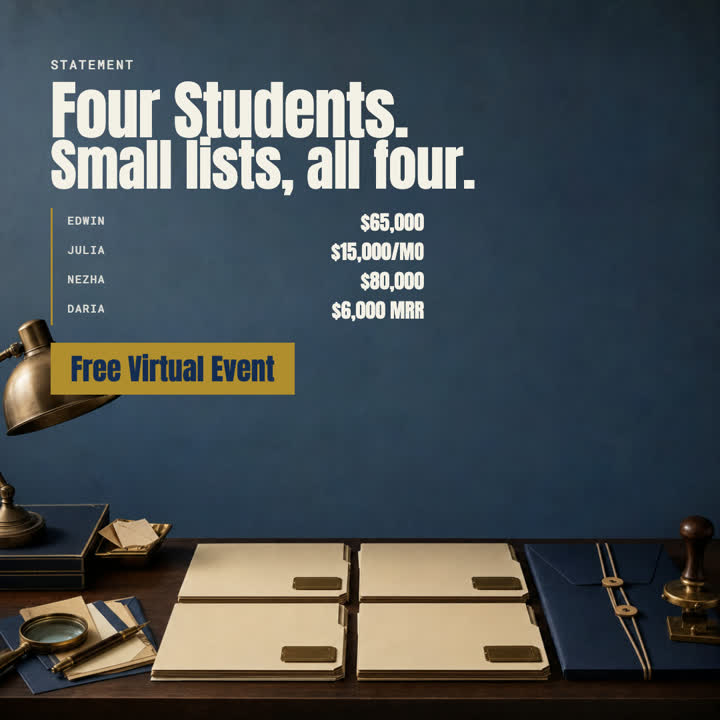
Four students. Four small lists. Four very different offers.
Edwin $65,000 from a single launch. Julia $0 to $15,000 a month. Nezha $80,000 in project work. Daria $6,000 recurring.
Free workshop on the common structure underneath.
Motion: rows stagger in one by one, 6s
NLA-19 · The Newsletter Blueprint
exploitR4staticno 2nd-person income claim
I call it the Newsletter Blueprint — five pillars behind more than $80M in subscriber revenue.
It is a structure, not a growth hack, which is why it holds at 900 subscribers and at 900,000.
Free 75-minute session.
NLA-20 · Small List, Real Revenue
exploitR4staticno 2nd-person income claim
A small list is not a smaller version of a big list. It is a different business with different economics.
Big lists sell attention to advertisers. Small lists sell outcomes to buyers — which is why 920 subscribers produced $1M ARR.
Free workshop on the structure.
NLA-21 · Not Bigger. Better.
exploitR4staticno 2nd-person income claim
More subscribers is the most expensive way to fix a revenue problem, and usually the wrong one.
My own newsletter did $1M ARR on 920 subscribers. A student does $70,000 a month on roughly 400.
Free 75-minute session on filling a list with the right people.
NLA-22 · What Is A Subscriber Worth?
exploitR4staticno 2nd-person income claim
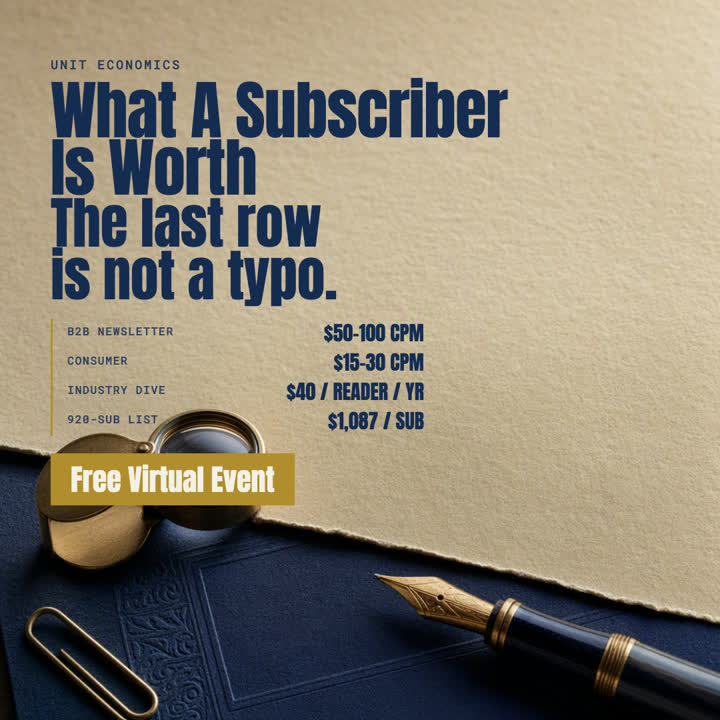
Sponsorship math prices a subscriber at a CPM. Offer math prices them at what they buy.
Industry Dive gets about $40 per reader per year. A 920-person list that produced $1M is over $1,000 per subscriber.
Same subscriber. Different business model. Free workshop on the second one.
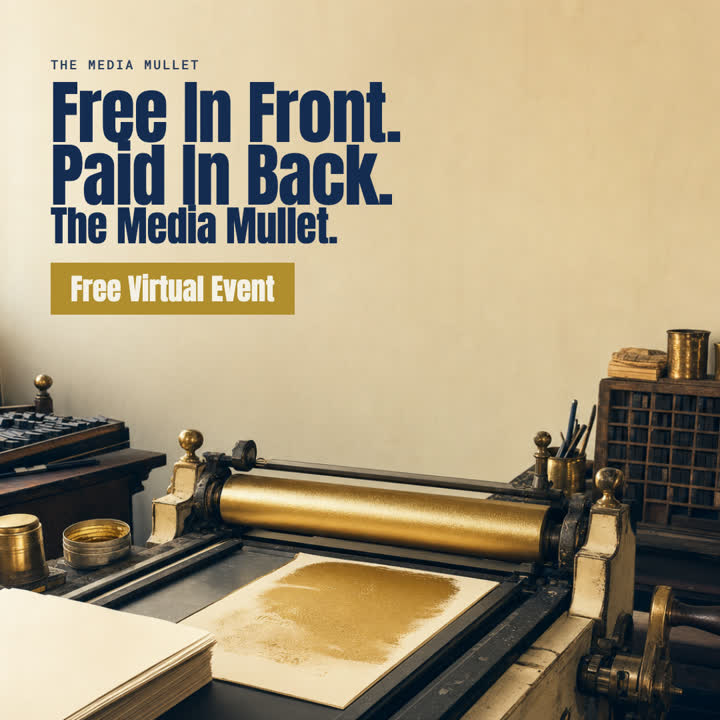
NLA-23 · The Media Mullet
exploitR4staticno 2nd-person income claim
I call it the media mullet: free and ad-supported in the front, high-value offer in the back.
Most newsletters build only the front half, then wonder why a 40,000-person list pays them less than a 900-person one.
Free 75-minute session on building the back half.
Nathan's term. It is the shape of nearly every profitable small newsletter.
NLA-24 · Business, Not Hobby
exploitR4staticsystem-break control
Your newsletter is a business. Most people run it like a hobby.
The difference is not effort or frequency. It's whether there is an offer at the end of it.
Free 75-minute session.
R4 — deliberate system BREAK. No blueprint furniture, no cream ground. Tests whether the design system carries the result or the message does.
NLA-25 · Five Pillars
exploitR4flexno 2nd-person income claim
Five pillars. More than $80M in subscriber revenue behind them.
Free 75-minute workshop.
Motion: the five axis ticks draw in sequentially, then the CTA bar wipes in, 6s
NLA-26 · 920 / $1,000,000
exploitR4flexno 2nd-person income claimsystem-break control
920 subscribers. $1,000,000 in annual recurring revenue.
Free workshop on the gap between those two numbers.
R4 — system break in motion. Tests the design system's contribution directly.
Motion: hard cut between the two numbers, no easing, 4s
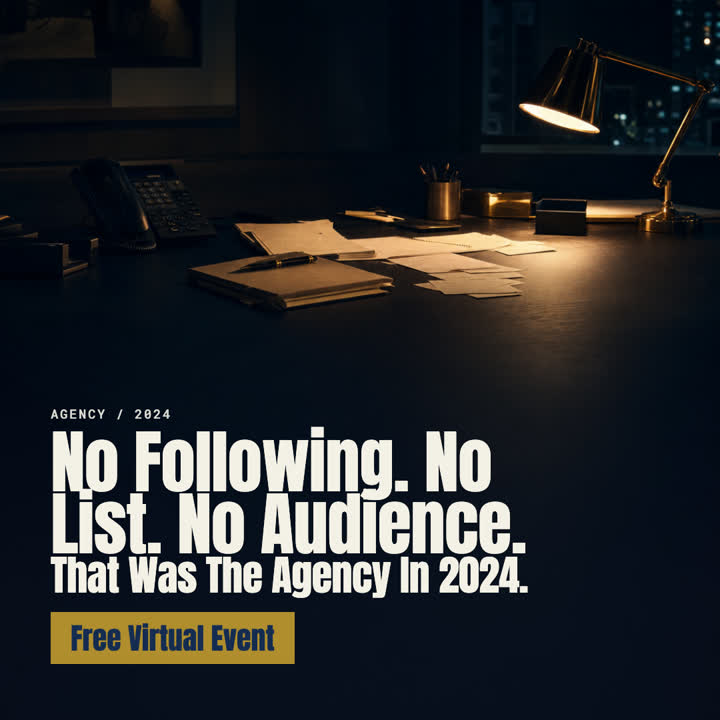
NLA-27 · The Agency In 2024
exploitR5staticno 2nd-person income claim
When I started my agency in 2024 I had no following on LinkedIn, no email list, and no audience.
So I did what everyone does: cold DMs, cold emails, posting and hoping. Some weeks I closed a client. Most weeks I didn't.
What changed it was sending a newsletter to a small list of people I actually wanted to work with.
Free 75-minute session on that exact move.
Sentence-case origin story. The all-caps callout version of this angle cost 60% more per registration.
NLA-28 · 5 Clients In 3 Weeks
exploitR5staticno 2nd-person income claim
Daria signed five clients at $1,500+ in three weeks.
Not from cold outreach. From a newsletter going to a small list of people she'd chosen deliberately.
A newsletter is the only channel where the prospect opts in and then hears from you every week without you asking again.
Free 75-minute session.
NLA-29 · DMs vs Newsletter
exploitR5flexno 2nd-person income claim
Cold DMs to the exact people I wanted as clients: mostly silence.
A newsletter to those same people: replies, then calls, then contracts.
Same list, same offer, different channel. Free 75-minute workshop.
Origin-story framing, sentence case, no financial-status callout.
Motion: the two lines cross-fade, DM UI dissolving into an inbox, 6s
NLA-30 · Another Way To Get Clients
exploitR5flexno 2nd-person income claim
Cold outreach works right up until you'd rather do anything else.
The alternative is a newsletter going to a small list of people you'd actually want to work with — which is how I rebuilt my own agency's pipeline in 2024.
Free 75-minute session.
Motion: kicker/mega/sub stack in on a 3-beat, blueprint rail draws under, 6s
09 — The explore arm
20 units the account has never tried
Qualification-forward copy designed to reduce registrations in exchange
for better ones, plus angles absent from all 28 historical copy variants.
NLA-31 · Not For Everyone
exploreR3staticno 2nd-person income claim
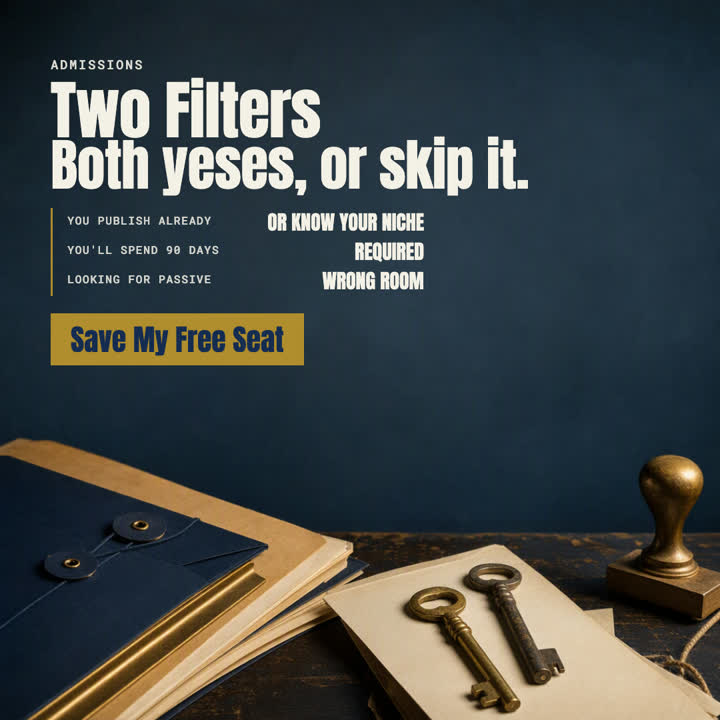
Two honest filters before you register:
This works if you already publish something, or you know exactly who you would write to. It does not work as a passive-income idea — the method takes about 90 days of real work.
If that's still a yes, the free 75-minute session is worth your time. If it isn't, skip it.
Deliberately disqualifying. Fewer registrations by design.
NLA-32 · Who This Is For
exploreR3staticno 2nd-person income claim
Who the session is for: people already publishing, or with a clear idea of who they'd publish to.
Who it isn't for: anyone looking for passive income, or a version of this that doesn't take 90 days of work.
Free, 75 minutes, no pitch until the end.
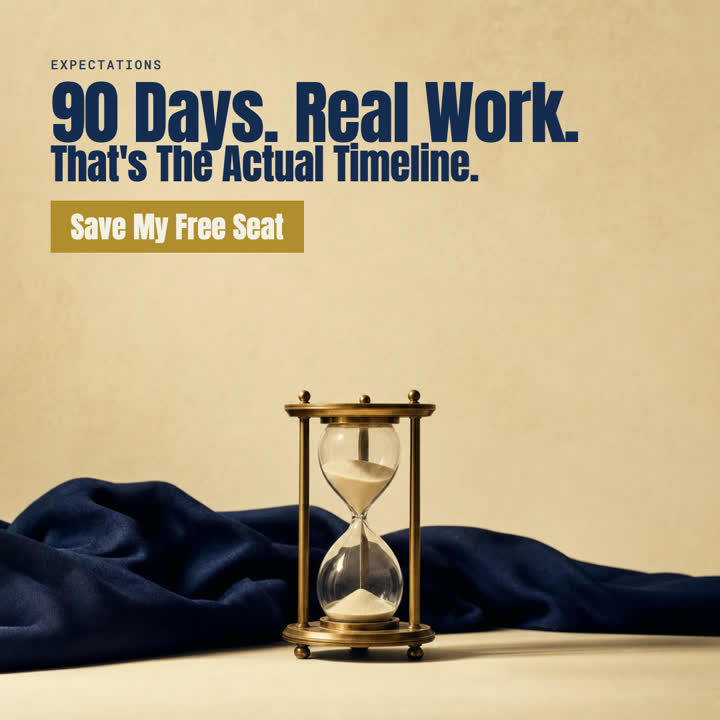
NLA-33 · 90 Days Of Real Work
exploreR3staticno 2nd-person income claim
The honest version: it takes about 90 days.
Not a weekend, not automated, not passive. Ninety days of publishing to a list you build on purpose, with an offer at the end of it.
That's the whole method, and I'll teach it free in 75 minutes.
Anti-hype framing. Sets the cost up front instead of at the pitch.
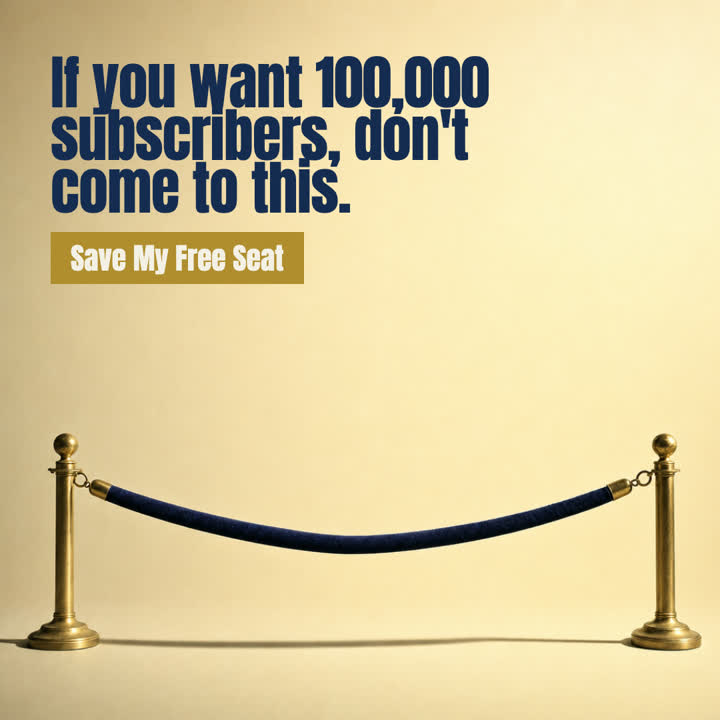
NLA-34 · Don't Come For The Vanity Metric
exploreR3staticno 2nd-person income claim
If your goal is 100,000 subscribers, this session will annoy you.
It's about what 900 of the right ones are worth — which, in my own case, was $1M ARR.
Free, 75 minutes.
NLA-36 · Both Yes, Or Skip It
exploreR3flexno 2nd-person income claim
Two filters. Both yes, or skip it.
Free 75-minute session on building a small list that buys.
Motion: each filter row stamps in with an APPROVED / DECLINED mark, 6s
NLA-37
exploreR6static
Most newsletter operators spend a year growing the list before they ever make an offer.
It's backwards. The offer is the thing that tells you whether the list was worth growing — and you can test it at 200 subscribers as easily as at 20,000.
Free 75-minute session on making the offer first.
Whitespace: 'offer before growth' has never been the hook in this account.
NLA-38 · What Sponsors Pay For
exploreR6staticno 2nd-person income claim
Sponsors do not buy list size. They buy access to a specific audience that buys things.
Which is why a 2,000-person newsletter in a defined niche can out-earn a 50,000-person general one on the same ad slot.
Free session covering direct sponsor sales and how the media kit should be priced.
NLA-39 · A Town Of 40,000
exploreR6staticno 2nd-person income claim
Naptown Scoop does about $400,000 a year in a town of 40,000 people.
No national audience. No viral growth. A local newsletter that a specific set of people genuinely need to read.
The ceiling on a niche is almost never the thing stopping a newsletter.
Free 75-minute session.
NLA-40
exploreR6staticno 2nd-person income claim
The most profitable newsletters I've worked on are boring.
Same useful thing, same specific people, same day every week. No format experiments, no growth hacks, no reinvention.
Boring compounds. Clever churns.
Free 75-minute session on building the boring version.
Whitespace: an anti-novelty angle. Nothing in the account has ever argued for less creativity.
NLA-41 · One Product, One List
exploreR6staticno 2nd-person income claim
Edwin launched one digital product to his own list and did $65,000. No ads, no affiliates, no launch team.
A newsletter is the only asset where the audience has already told you what they want by staying subscribed.
Free session on turning that into a product.
NLA-42
exploreR6staticno 2nd-person income claim
Every social post starts from zero. Every search result starts from zero.
A newsletter is the only channel where someone raises their hand once and then hears from you every week without being asked again.
That structural advantage is worth more than any algorithm.
Free 75-minute session.
Whitespace: channel-structure argument. Never used as a hook.
NLA-43 · Four People, $6M
exploreR6staticno 2nd-person income claim
Hustle Trends: about $6M in revenue, roughly 90% margin, four people.
That margin is why newsletters are a better business than almost anything else you could build with four people.
Free 75-minute session on the structure behind it.
NLA-44 · Nobody Taught The Second Half
exploreR6staticno 2nd-person income claim
Every piece of newsletter advice is about growth. Almost none of it is about what happens after someone subscribes.
That second half is where the money is, and it's the part nobody teaches.
Free 75-minute session.
NLA-48 · Not List Size
exploreR6flexno 2nd-person income claim
Sponsors don't buy list size. Free 75-minute session on what they actually buy.
Motion: the 'LIST SIZE / NOT IT' row strikes through, remaining rows weight up, 6s
NLA-49 · The Only Channel That Compounds
exploreR6flexno 2nd-person income claim
Social resets every post. A newsletter doesn't.
Free 75-minute session on the only channel that compounds.
Motion: a social feed scrolls past and dissolves into a single inbox line, 7s
NLA-50 · 90% Margin
exploreR6flexno 2nd-person income claim
$6M, four people, ~90% margin.
Free 75-minute session on why newsletters have those economics.
Motion: margin figure counts up as the team-size figure counts down, 5s
10 — Video
10 of 10 video units
Rendered from HTML through HyperFrames — deterministic, no video model in the words. Wave 2
puts a cinematic 9:16 image plate behind every script with a slow push-in, a radial scrim, and
cream type — the same hybrid as the statics (Wave 1's flat typographic versions were rejected
along with the statics). Six of them are the duration ladder: identical scripts at 12s, 20s and
35s so the length question becomes measurable. No founder footage exists in any
system we can reach; when Nathan shoots even 10 minutes of direct-to-camera, these same
compositions take his footage as the plate layer.
NLA-13 · Duration Probe A/12s
exploitR2video12sno 2nd-person income claim
920 subscribers turned into $1M ARR in 10.5 months.
Free 75-minute workshop on how.
Deliberate falsification probe against our own length hypothesis. 35s units exist BECAUSE the data does not support a hard 20s cap.
Treatment: cinematic archetype — no text on the opening frame (mirrors DCT 138, the account's best video at $7.37 CPR); blueprint end card
NLA-14 · Duration Probe A/20s
exploitR2video20sno 2nd-person income claim
920 subscribers turned into $1M ARR in 10.5 months.
Free 75-minute workshop on how.
Deliberate falsification probe against our own length hypothesis. 35s units exist BECAUSE the data does not support a hard 20s cap.
Treatment: cinematic archetype — no text on the opening frame (mirrors DCT 138, the account's best video at $7.37 CPR); blueprint end card
NLA-15 · Duration Probe A/35s
exploitR2video35sno 2nd-person income claim
920 subscribers turned into $1M ARR in 10.5 months.
Free 75-minute workshop on how.
Deliberate falsification probe against our own length hypothesis. 35s units exist BECAUSE the data does not support a hard 20s cap.
Treatment: cinematic archetype — no text on the opening frame (mirrors DCT 138, the account's best video at $7.37 CPR); blueprint end card
NLA-16 · Duration Probe B/12s
exploitR2video12sno 2nd-person income claim
A ~400-subscriber newsletter making $70,000 a month.
Free 75-minute workshop on how.
Deliberate falsification probe against our own length hypothesis. 35s units exist BECAUSE the data does not support a hard 20s cap.
Treatment: cinematic archetype — no text on the opening frame (mirrors DCT 138, the account's best video at $7.37 CPR); blueprint end card
NLA-17 · Duration Probe B/20s
exploitR2video20sno 2nd-person income claim
A ~400-subscriber newsletter making $70,000 a month.
Free 75-minute workshop on how.
Deliberate falsification probe against our own length hypothesis. 35s units exist BECAUSE the data does not support a hard 20s cap.
Treatment: cinematic archetype — no text on the opening frame (mirrors DCT 138, the account's best video at $7.37 CPR); blueprint end card
NLA-18 · Duration Probe B/35s
exploitR2video35sno 2nd-person income claim
A ~400-subscriber newsletter making $70,000 a month.
Free 75-minute workshop on how.
Deliberate falsification probe against our own length hypothesis. 35s units exist BECAUSE the data does not support a hard 20s cap.
Treatment: cinematic archetype — no text on the opening frame (mirrors DCT 138, the account's best video at $7.37 CPR); blueprint end card
NLA-35 · Two Filters
exploreR3video18sno 2nd-person income claim
Two filters before you register. Both have to be a yes.
Free 75-minute session.
Treatment: direct-to-camera, no text on opening frame, blueprint end card
NLA-45 · The Second Half
exploreR6video16sno 2nd-person income claim
Everyone told you to grow the list.
Free 75-minute session.
whitespace: post-subscribe framing
Treatment: cinematic, no opening text, blueprint end card
NLA-46 · A Town Of 40,000
exploreR6video18sno 2nd-person income claim
Naptown Scoop does four hundred thousand dollars a year.
Free 75-minute session.
whitespace: niche-ceiling myth
Treatment: cinematic, no opening text, blueprint end card
NLA-47 · Boring Compounds
exploreR6video20sno 2nd-person income claim
The best newsletters I've worked on are boring.
Free 75-minute session.
whitespace: anti-novelty
Treatment: cinematic, no opening text, blueprint end card
11 — The cheap-model arm
What happens if you generate these locally instead
The statics above are HTML rendered by headless Chrome, which makes typography exact. The
fair question is whether an image model could do the same job. We re-issued six of the briefs
verbatim to two models running locally on an RTX 5090 — SDXL 1.0 and
Z-Image Turbo — same brief, same aspect, same seed, same QA rubric.
~4sPer image, warm (both models)
32 GBVRAM available
$0Marginal cost per image
0 / 6Usable as finished ads
HTML / headless Chrome Text exact. Typeface exact. This is
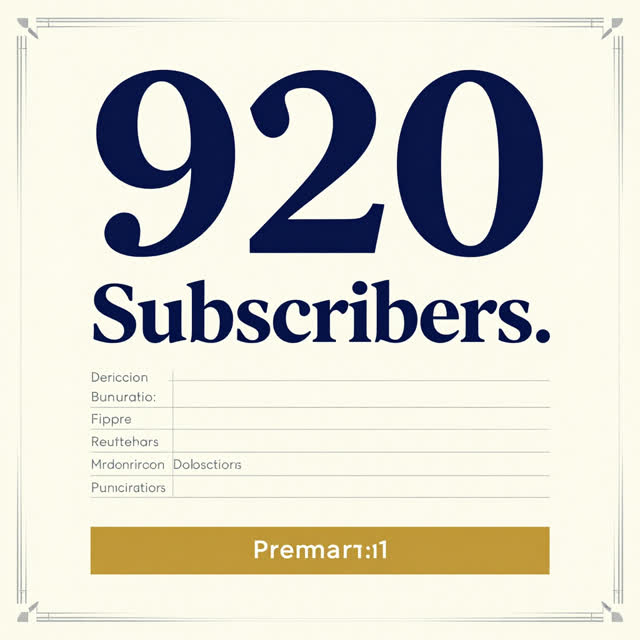
the shipped unit.Z-Image Turbo (local) Headline “920 Subscribers.”
rendered correctly. But the spec table is gibberish
(“Dericcion / Bunuratio / Fippre”), the CTA reads “Premar1:1”, and it
ignored the typeface spec for a Didone serif.SDXL 1.0 (local) Aesthetic vocabulary right — cream stock,
navy, gold, drafting linework. Text entirely wrong: “920” became
“602”, everything else is noise.
The honest read is more interesting than “local models are worse.” Both models
understood the art direction immediately — cream stock, navy and ochre, blueprint
furniture — and a 2026 local model (Z-Image) renders a headline correctly where a 2023 one
(SDXL) cannot. The failure is specific and it is the same failure in both: everything
below the headline. Secondary text, spec tables, CTA labels and exact typeface are all
out of reach.
And on this account the failure is not just aesthetic. Asked for
“$70,000 Per Month”, SDXL rendered “$767009”. On an ad
account already being rejected for earnings claims, a model that invents a number inside a
financial claim is a compliance liability, not a quality problem. That is the argument for
HTML rendering on text-heavy creative — not that it looks better, but that
it cannot say something you didn't write.
Where local models do earn their place on this build: art direction exploration,
background plates, and any surface with little or no literal text. At ~4 seconds and no marginal
cost, they are excellent for deciding what a thing should look like — just not for
producing the final artwork that a compliance reviewer reads.
12 — Method
How this was actually made
Data. Direct Meta Graph API pull — 151 ads, 134 creatives, 2,656
adcreatives, 205 images, 101 videos. No dashboard in the loop.
Analysis. Unit of analysis is the distinct creative asset, never
the ad row — collapsing that distinction is what produced the false length finding. Eligibility
is spend ≥ $400 only; adding a conversion threshold would select on the outcome
variable.
Adversarial review. The plan was scored by three independent models across
three rounds. Every correction in section 03 came out of that process; the reviewers disagreed
with each other by up to 39 points, and the disagreements were where the real defects were.
Statics (three attempts, honestly). Wave 1: pure HTML/Chrome typography —
rejected as flat. Wave 2: GPT Image 2 plates + HTML type — rejected for type collisions. Wave 3
(shipped): dual-engine ensemble — Nano Banana Pro + Gemini 3.1 Flash Image generate each
complete ad in parallel; qwen3-vl on an RTX 5090 OCR-gates text fidelity; a blind judge picks
per unit against the account's best-ever ad; failed pairs are regenerated on an assigned
engine. Routing: 30 / 9 / 1 across the three engines.
Judging discipline. The OCR gate produced 6 false negatives — useful
screen, never the verdict. Every 0.0 was adjudicated on pixels before any redo. The judge's one
systematic finding (“engines truncate 4-row tables”) traced to a slice bug in our
own prompt builder, not the models.
Video. HyperFrames, 1080×1920, deterministic frame-stepped render
over cinematic 9:16 plates with a slow push-in. Next upgrade: Seedance 2.0 image-to-video on
the winning stills.
Local arm. ComfyUI on an RTX 5090 over Tailscale, SDXL 1.0 and Z-Image
Turbo — the experiment that produced the (correct-for-local, wrong-for-frontier)
“models can't do text” premise. The same 5090 redeemed itself as the OCR gate.
What we could not do. The account is read-only to us
(ANALYZE), so none of this has been published and none of it has outcome data.
This is a portfolio and a test design, not an experiment — and it is labelled that way
deliberately.